A R C H I T E C T U R A L
A S S O C I A T I O N
O F
I R E L A N D

|
A R C H I T E C T U R A L A S S O C I A T I O N O F I R E L A N D
|
. |
|
A S S E S S O R S Alberto Campo Baeza . Kevin Kieran . Edward McParland . Esmonde O'Brian . Sheila O'Donnell |
A S S E S S O R S
Alberto Campo Baeza was born in Cadiz, Spain. He studied architecture in Madrid, graduating with a degree in 1971 and a PhD in 1982. His buildings include Fene Town Hall; a library in Orihuela; schools in Cadiz and Madrid; numerous private houses. A bank HQ in Grenada and high-tech offices in Mallorca are currently under construction. He has taught and lectured widely. His work has been exhibited and published internationally, including a book of collected writings, The Built Idea, and a monograph, Campo Baeza, 1971-1996.
Kevin Kieran graduated as an architect from University College Dublin. He studied at the Harvard University Graduate School of Design, graduating with an MArch degree. From 1985 he lectured at Harvard, where he was appointed Associate Professor and Director of the Architecture Programmes. He has also lectured at other schools in the US. For a number of years he was in practice in Cambridge, Mass. In 1997 he returned to Ireland as Architecture Consultant to the Arts Council. He is currently teaching at UCD and is in practice in Dublin.
Edward McParland was born in Dublin in 1943. After studying architecture in UCD (for 6 weeks), he took up mathematics. He studied the history of art in Cambridge, returning in 1973 to lecture in the Dept of the History of Art in Trinity College Dublin, a post he still holds. His book, James Gandon, was published in 1985. He was co-founder, with Nicholas Robinson, of the Irish Architectural Archive. He is on the Committee of Management of the Irish Georgian Foundation, and is a dirctor of the Irish Landmark Trust.
Esmonde O'Brian (b. 1964) graduated from University College Dublin in 1988. He worked in London with Loelter Kim, and in London and Stuttgart with Stirling Wilford. On returning to Dublin in 1992, he worked with Derek Tynan Architects. In 1995 he established O'Brian O'Donnell Architects. He has been a visiting critic to final year at DIT, Bolton Street since 1996.
Sheila O'Donnell is a graduate of UCD and the RCA, London. She set up in partnership in Dublin with John Tuomey in 1988. Their work has been widely published, and they have won many awards, including the AAI Downes Medal in 1988, 1990, 1992 and 1997. She teaches regularly in UCD, and is a visiting critic and external examiner in schools in Britain and the US. She was a founder member of Group 91, the city Architecture Studio, and the Blue Studio architecture gallery. She is currently working on educational and cultural buildings.
ARCHITECTURAL ASSOCIATION OF IRELAND AWARDS 13
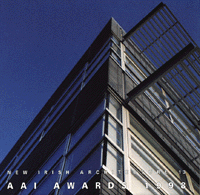
The AAI Awards were established in 1986 as "an annual award scheme for excellence in architectural design". The intentions of the Awards are:
- to encourage higher standards of architecture throughout the country
- to recognise projects which make a contribution to Irish architecture
- to inform the public of emerging directions in contemporary architecture
The Awards are open to architects practising in Ireland and Irish architects practising in their own right abroad, submitting current projects and buildings.
Entries are judged by a panel of five assessors - a foreign assessor, two invited Irish assessors, a representative of the previous year's Award winners, and a distinguished non-architect. This year's foreign assessor was Alberto Campo Baeza.
The results are exhibited and published annually as New Irish Architecture. The publication contains assessors' commentary as well as more extensive project descriptions than listed above. Volumes 8, 9, 11 and 12 are available in bookshops or direct from Gandon Editions.
|
|
 |
|
|
|
|
. INDEX . LECTURES + EVENTS . ARCHIVE . LINKS .
|
|
|